The idea of Blasphemy in Muslim scriptural sources and its interpretation in fiqh.


“I call on all brave Muslims wherever they may be in the world to kill them without delay so that no one will dare insult the sacred beliefs of Muslims henceforth….and whoever is killed in this cause will be a martyr, Allah Willing.[1]”
The supreme leader of Iran, Ayatollah Khomeini’s legal judgment over the author of the book ‘Satanic verses’ and associated publishers on February of 1989 echoed all around the world. When Salman Rushdie wrote the controversial book Satanic Verse, the worst he expected was some angry Mullah’s (clerics) calling him names[2]. However, the Rushdie Affair ended in thousands of brutal protests, hundreds of deaths, tens of burning buildings and even countries severing diplomatic ties. Why did Rushdie’s alleged Blasphemy outrage the entire Muslim world? What is the concept of Blasphemy in Islam and how has it evolved? What do Islamic scriptures say about Blasphemy and how have the jurists interpreted it?
This article attempts to look at the discussions of Blasphemy in Muslim scriptural sources such as the Qur’an and Hadith. In addition, the essay will also touch upon the interpretations of the meaning and effects of blasphemy in Islamic Jurisprudence (Fiqh). The paper doesn’t attempt an in-depth analysis in each of the area as the scope of paper is limited, however, it will touch upon some points to discuss the normative and descriptive status of blasphemy in the Qur’an and Hadith. As regards fiqh, the essay focuses only on two schools of thoughts that are the most different in and their basic religious philosophy i.e Shafi school and the Jaffari. The essay will first attempt to etymologically define blasphemy followed by a discussion on status of blasphemy in the Qur’an, Hadith and fiqh respectively.
Defining Blasphemy
Blasphemy has remained an everchanging concept since its origins. The term Blasphemy is derived from the Greek work blas-phemeo. Blas means wrong, and phemi translates into ‘speaking’, hence “to injure, speak ill of, culminate”[3]. Blasphemy in the Greek period might have meant to hurl “insults in actions or speech against God or those he has sent”.[4] In that, etymologically, blasphemy is an act of speaking or doing ill against God.
Besides, blasphemy can also mean ridiculing ideas or objects that are associated with God or held sacred[5]. In Christian traditions, blasphemy has remained associated with an act of treason. The Bible explicitly classifies the offence as taking the name of Lord in vain and Blasphemers were considered to have committed the crime of treason by putting themselves above God. [6] However, it is essential to keep in mind that the term ‘traditions’ itself is problematic. Traditions contain divergences and tensions and do not represent a unanimous affirmation by an entire civilisation.
Admittedly, the Islamic ideas of blasphemy also delve in such divergences and tensions. The Arabic word that most closely relates to the English word Blasphemy is ‘tajdīf’. The word tajdīf with root word Jim-Dal-Fa means ungratefulness or thanklessness of the gifts particularly the ones from God.[7] Tajdīf, as a theological term, has been used by Christian Arabs to translate what in European religious history was termed as Blasphemy[8]. Another term that is used in Arabic to define blasphemy is sabb. Sabb, however, does not necessarily need to have any religious connotation at all and has been used as more general noun deriving from a noun meaning ‘to curse’ or ‘to insult’[9].
Blasphemy in the Qur’an
To examine what the Qur’an says about Blasphemy, it is crucial to understand the complicated and vague domain of the Quranic Ethos. Like many other concepts, the idea of Blasphemy also carries the challenges and anomalies of intricate linguistic difficulties. For instance, the Arabic term Tajdīf does not occur anywhere in the Qur’an. Does that mean that the Qur’an completely refrains from all condemnations of blasphemy? While it is true that the Qur’an does not come out as strong in condemnation of blasphemy as the Bible, to say that the Qur’an is totally oblivious to the concept of blasphemy would be an understatement if not outright false.
Equally important is to look at the entire worldview of the Qur’an in which individual key concepts exist with other concepts that form a, what Izutsu calls, ‘a conceptual network’[10]. In that, Izutsu reminds us of an intricate interdependence of words and concepts in the Qur’an that do not occur in complete isolation but rather create an entire system of relations[11]. However, this framework of analysing critical concepts in the Qur’an is not without risks of falling into the trap of concluding results based on personal interpretations of overlapping concepts. In addition, It also becomes important to unpack the semantic, linguistic and cultural baggage of some of the earlier usage of Arabic words as used in the Qur’an to avoid the danger of falling onto single surfaced meaning[12]. Blasphemy in the Qur’an is one such concept which according to many jurists overlaps into the realms of sabb ( insult), Kufr, (infidelity), ilhād, (apostasy) and fisq (moral depravity).
The term sabb is generally used as a noun derived from the verb means ‘to curse’, or ‘to insult’. In the Qur’an, the term occurs only twice in one verse.

Sabb with root letters of Seen-Baa-Baa has a range of meanings including ‘ a relation’, ‘a course’, and ‘a rope’. The derivate verb, however, has been explicitly used to express an action of causing insult or ‘injury through speech’. According to al-Wāḥidī’s Asbāb al-nuzūl, the Meccan verse Q.6:108 was revealed as a result of a reaction of the people of Quraysh to Muhammad’s denial of their idols. Interestingly, in stark contrast to the Bible (which categorically calls for the blasphemer to be stoned to death), the Qur’an simply admonishes the Muslims and asks them to refrain from passing any insults at the pagan Idols in case they retort back with the same for Allah.
If we take the modern definition of Blasphemy as a criterion, then mocking at the revelation can also fall under the domain of blasphemy. The Qur’an addresses the mocking at the revelation of non-believers in relation to their arrogance and haughtiness. If there is any concept connected with the egotism of the non-believer, it has to do with mocking at whatever the Prophet has brought[14]. The most common expression that occurs in the Qur’an that translates into the English meaning of ‘Mocking at’ is istiḥāḍa have the roots of Ha-Za-Hamza. Although any Arabic word may have a range of meanings, the 34 instances of the term istiḥāḍa that occur in the Qur’an almost consistently translate into ‘Mocking’ or ridicule.
The Qur’an repeatedly establishes, at times almost sarcastically, that the unbelievers who mock at the revelation and the prophets do so as a result of their own ‘laughable’ ignorance. For instance, in Q.2:15 the result of laughing at God’s revelation is becoming the subject of mockery themselves.

Also noteworthy is the passive course of action that the Qur’an suggests upon being ridiculed or mocked by non-believers. For example, in verse Q.4:140, the prophet is simply instructed to avoid gatherings where God and his verses are derided.
The process of analysing linguistic emphasis in the interpretation of Quranic verses has always been challenging for scholars and jurist. Consequently, the translation and exegesis of some verses render meanings in a range of a vast spectrum. The term ‘yul'ḥidūna’, for instance, has been translated to mean as Blasphemy by many scholars.
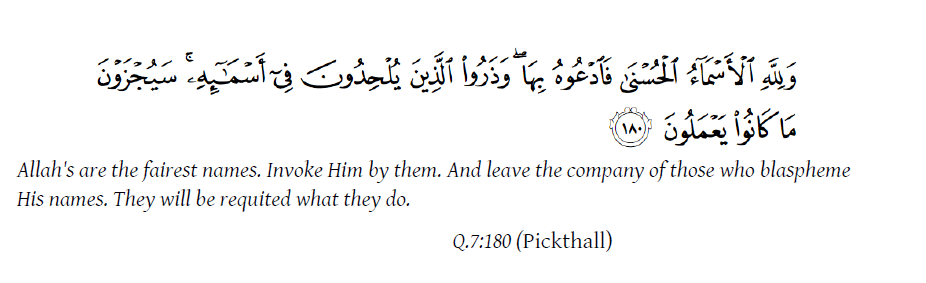
The triliteral root lām ḥā dāl occurs on six instances in the Qur’an and has a range of meaning including ‘ to digress from the right path’, ‘deviate’, and ‘apostasy’. In the above verse, however, the Qur’an does seem to imply profanity by the use of ‘yul'ḥidūna’ in a context that deals with exalting names of Allah. Interestingly, a punishment will result in such blasphemy though the nature of the punishment itself is obscure.
Many jurists over the centuries have argued that other connotations of Blasphemy in the Qur’an lurk behind the terms such as shirk (polytheism) and kufr ( infidelity). Based on their usage in the Qur’an and the context, it seems that the terms share a common semantic field, as in the analysis employed by Izutsu, of which a sense of ‘blasphemy’ is a common substratum[15]. However, considering a modern definition of Blasphemy as merely ridiculing or criticising the sacred, the Qur’anic tone does not seem to be very stern about it.
Blasphemy in Ḥadīt̲h̲
The Arabic term most commonly used in the Ḥadīt̲h̲ collection that translates into the modern definition of blasphemy is sabb. Contrary to the Qur’an, the Ḥadīt̲h̲ literature extensively discusses the issue of Blasphemy and related penalties. While the authenticity and context of some of the Ḥadīt̲h̲ will be discussed, all canonical Ḥadīt̲h̲ collections carry the common theme suggesting that insults hurled at God, Prophet or his companions is “intolerable and therefore forbidden”[16]. However, there are also several Ḥadīt̲h̲ that narrate instances where Prophet was insulted, mocked or even physically assaulted and the perpetrators were dealt with utmost kindness. Such stark contradictions are a common theme of the Ḥadīt̲h̲ literature.
Among many Ḥadīt̲h̲s that deal with Blasphemy, one most commonly mentioned is narrated on the authority of Ali, Prophet’s cousin and one of closest companions, mentions Muḥammad commanding to “kill anyone who abuses a Prophet and whip the one who abuses my companions” [17]. However, the authenticity of this Ḥadīt̲h̲ is challenged by multiple commentators and has been called weak (da’eef) because the chain of narration consists of individuals whose authority is questionable, and this Ḥadīt̲h̲ therefore isn’t reliable[18].
In contrast to the above-mentioned Ḥadīt̲h̲, there are examples such as the case of Hubaira bin Abi Wahhāb who wrote odes against prophet Muhammad, but the Prophet prayed for him instead[19]. Another instance of forgiveness for the blasphemer is stated by Ismail ibn Kathir about Abdulah bin Obi who reportedly called the prophet a ‘with derogatory names’ and condemned the residents of Madīna for not exiling the Prophet. The companions rushed to kill the blasphemer, but the Prophet disallowed it[20].
The above-mentioned examples are just a scratch on the surface of a plethora of such contradictions in the Ḥadīt̲h̲ literature. In addition, a critical reflection on the earliest Islamic society shows that status of the Prophet among people to have been exalted to ‘God-like’ might be a later era construction. Ridicule and mockery, specially through poetry, had been an integral part of the Arab society. For instance, ak̲h̲bār from as late as the ʿAbbāsid period show that several poets of the time ‘practiced parodic use of the Qur’an’[21].
In addition, the poets used to subvert the Qur’an at certain times and certain places and evidence indicates their selected audience enjoyed, or at least tolerated, this[22]. Based on this observation, it is safe to assume that if the Qur’an ( though in certain settings) was a subject of criticism, the critique or mockery of the prophet might also have been somewhat tolerated.
Blasphemy in fiqh
The concept of Blasphemy as a major offense in Islamic Jurisprudence ( fiqh) seems to have emerged during the 3rd/9th century. Interestingly, most of the earliest jurists have produced works focused on blasphemy against Prophet Muhammad and his companions rather than blasphemy against God. Sabb is the Arabic term widely used by jurist for blasphemy along with ridda ( apostasy ) and kufr ( unbelief ).
Furthermore, sources indicate that the introduction of Blasphemy against Prophet Muhammad into the chapters on apostasy and unbelief in the legal manual happened only after the formative texts of the legal schools had been complied.[23] Although all jurisprudence contains factor of interpretation of the Qur’an and Ḥadīt̲h̲, the issues such as blasphemy might have gone through much wider field of personal interpretations as they were incorporated into legal manuals at a much later time.
Jurists from all major Islamic schools of thoughts categorically condemn acts of Blasphemy. Nevertheless, there is a wide range in difference of opinion on the associated questions such as what constitutes blasphemy? How blasphemy should be punished? How a Muslim vs Non-Muslim blasphemer should be dealt with? Also, based on their understanding , majority of the jurist have have categorized blasphemy in the domain of riddah and kufr[24].
The famous Shafi jurist Taqi al-Din al-Subki ( d. 755/1354) draws upon Ḥadīt̲h̲ literature, particualry from al-Tirmidhi’s Jami' at-Tirmidhi to develop his explanation of blasphemy. Al-Subki holds that any Muslim who speaks ill against Muhammad or his Companions violates the consensus of the community and hence must be treated as having abandoned Islam resulting in apostasy[25]. According to Al-Subki, blasphemy against the Prophet or any of his companions is punishable by death. He relies heavily on Ḥadīt̲h̲ literature to prove his point using a statement attributed to the prophet saying , “whoever insults the Prophet should be killed”. However, al-Subki himself seems quite aware that the authenticity of such sayings of Prophet is dubious.
A vast majority of the Twelver Shi’a jurists also deem blasphemy as a punishable offense. The basis of their jurisprudence is based on a Ḥadīt̲h̲ from Al-Kafi which narrates the account of one Muhammad Ibn Muslim who inquired from Abū Jaʿfar (al- Bāqir) about the punishment of the blasphemer[26]. Abū Jaʿfar is recorded saying “if you don’t fear for yourself, then kill him ( the blasphemer).[27] It’s interesting to note that insulting an imam is also deemed as blasphemy by some Shi’a jurist such as Ibn Zura al-Halabi(d. 585 AH/1189 CE) and Ali ibn Ahmad al-Amili(d. 1011 AH/1602 CE) and hence punishable by death.
In the Islamic traditions, blasphemy has always remained a condemnable act. In the Qur’an, though the exact modern Arabic term for blasphemy might not be used but the notion of mocking or ridiculing the sacred is discouraged. In the Hadith, blasphemy remains an extensive subject of discussion. There is at time great contradiction in the outcome of blasphemy but that’s true for many other ideas in the Hadith literature. In both Shi’a and Sunni Fiqh, blasphemy is a terrible act and is a strictly punishable crime. Though, like in many other matters, all the schools of thoughts vastly differ on the subject.
[1] " Ayatollah Sentences Author To Death", News.Bbc.Co.Uk, 2019, http://news.bbc.co.uk/onthisday/hi/dates/stories/february/14/newsid_2541000/2541149.stm. [2] Ian Richard. Netton, Text and Trauma: an East-West Primer (Surrey: Curzon Press, 1996), [3] Roy W. Perret, “Blasphemy,” Sophia 26, no. 2 (1987), 4. [4] Perret,Blasphemy,5. [5] Anthony Fisher and Hayden Ramsey, 2000, ‘Of Art and Blasphemy’, Ethical Theory and Moral Practice, vol. 3, pp. 137-167, 38. [6] David S. Nash, Blasphemy in the Christian World: a History (Oxford: Oxford Univ. Press, 2010), 2. [7] Edward William Lane, An Arabic-English Lexicon, Part 2 Jim-Kha, (Beirut:Librairie du Liban, 1968),p.391 [8] Asad, Is Critique Secular?, 38. [9] Ian Richard. Netton, Text and Trauma: an East-West Primer (Surrey: Curzon Press, 1996), p.6) [10]Toshihiko Izutsu, God and Man in the Koran: Semantics of the Koranic Weltanschauung (Tokyo: The Keio Institute of Cultural and Linguistic Studies, 2002),p.12) [11] Izutsu, God and Man in the Koran,12. [12] Netton, Text and Trauma,5. [13] Q.6:108 ( Pickthall ) [14] Toshihiko Izutsu, Ethico-Religious Concepts In The Qur'ān (repr., Montreal: McGill-Queen's Univ. Press, 2002). [15] Netton, Text and Trauma,5 [16] Lutz Wiederhold, “Blasphemy against the Prophet and His Companions,” Journal of Semitic Studies 42, no. 1 (January 1997): pp. 42 [17]Kitāb al-Shifāʾ bīTaʾrif Ḥuqūq al-Muṣṭafá, Qazi Ayaz, Vol.11 p 194 [18] Arafat Mazhar, “The untold story of Pakistan’s Blasphemy laws, A reconciliation with the past and a way forward,” Research report by Engage, www.engagepakistan.com. [19] Seerah ibn e Hisham, Vol 4, p39. In Arafat Mazhar, “The untold story of Pakistan’s Blasphemy laws” 97. [20] Ismāʻīl ibn ʻUmar Ibn Kathīr and Muhammad Nasib Ar-Rifa'i, Tafsir (repr., London: Al-Firdous, 1998). [21] Nuha Alshaar, Qur'an And Adab, 1st ed. (repr., London: OUP/Institute of Ismaili Studie, 2016), 156. [22] Alshaar, Qur'an And Adab, 156. [23] Lutz Wiederhold, “Blasphemy against the Prophet and His Companions,” Journal of Semitic Studies 42, no. 1 (January 1997): pp. 39-70 [24] Fierro, 'Andalusian "Fatawa" on Blasphemy', 110. See Bernard Lewis, 'Behind the Rushdie Affair', The American Scholar 60 (1991), 187; T. Andrae, Die Person Muhammads in Lehre und Glauben seiner Gemeinde (Stockholm 1918), 264 [25] Wiederhold, Blasphemy against the Prophet and His Companions,64. [26] Muḥammad ibn Yaʻqūb Kulaynī and Muḥammad Riḍā Jaʻfarī, Al-Kāfī (repr., Tehran, Iran: WOFIS World Organization for Islamic Services, 1978). 256 [27] Al-Kafi,vol7,256.


Comments